The Witcher 3 Wild Hunt | Review
My favourite video game of all time, which has marked a turning point in my life.
« BackI always wonder what the timeline looks like, in which I didn't get into gaming, and specifically, The Witcher 3: Wild Hunt. It may sound exaggerated, but the discovery of this masterpiece of a game marked a turning point in my life, shaping not only my interests but also my career path.
As I also want to start writing about the games I play, it felt natural to pick this one as the first in this category of posts, although I feel it necessary to add the disclaimer, that this review is biased. The Witcher 3 was among the first video games I ever played, right at the onset of COVID (I was a late bloomer in regard to gaming) and also comes with strong emotional ties to it. Nonetheless, the game does deserve all its praise, which also seems to be the general consensus among gamers.
In contrast to future reviews, this one is certainly going to be a bit more personal, but I don't necessary see this as a bad thing; I myself enjoy reading about or listening to the emotional impact games had on other players, and I do see it as part of what makes a good game.
Thus, I hope you enjoy this review of CD Projekt Red's third title in the video game adaptation of Andrzej Sapkowski's The Witcher Saga.
Quick Facts
Developer: CD Projekt Red
Publisher: CD Projekt
Release: 19 May 2015
Platforms: Windows, PlayStation 4 & 5, Xbox One, Xbox Series X/S, Nintendo Switch
Genre: Open-World, Action-RPG
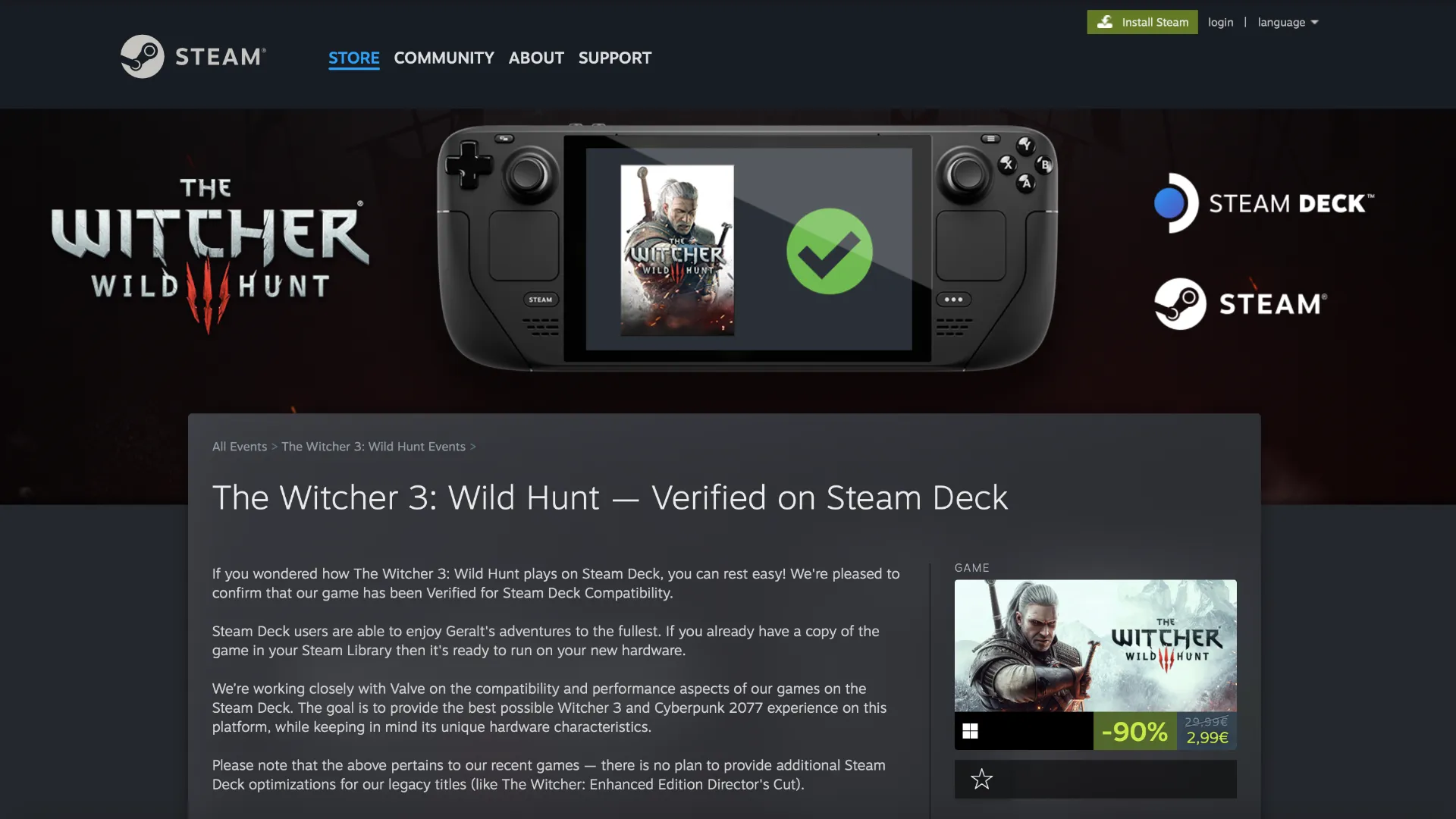
Steam Deck Compatibility: Deck Verified
Introduction
In case of this game, I see it as relevant to actually give a brief insight into my interests and passions before my first playthrough, as it creates a more powerful comparison in my opinion on just how much The Witcher 3 shaped my life upon its discovery.
Before I got into gaming, I was focusing heavily on 3D modeling and visualising products, and had actually planned on becoming a product designer. It was part of the reason for why I began my industrial design studies back in 2020. I also wasn't at all into the fantasy genre, having always been into science fiction universes such as the ones from Star Wars or Buck Rogers. Retrospectively, it feels baffling to me, that I used to perceive movies such as Lord of the Rings as boring, and couldn't immerse myself at all into their worlds.
It was shortly before the COVID outbreak, that I took the fairly random decision to purchase my first ever video game console, having never truly been interested in gaming before. As I researched titles to play, there was one game cited across multiple posts and videos, more often than not referred to as the greatest video game of all time - The Witcher 3: Wild Hunt.
At first, it didn't really speak to me given its genre and setting, yet the more videos I watched on it, the more I got fascinated by the world and gameplay, until I decided to give it a try.
To say I was captivated is a massive understatement. From the moment I started the game, I was hooked, to the point of having played it from early morning hours till late at night, drawn into its world and story. I would bombard those around me with details from the game and its plot, and became incredibly passionate about it.
Fascinated by the game, I began watching a lot of behind-the-scenes content, as I wanted to know how it was created, which was when I discovered the role of a 3D character artist, marking the beginning of me exploring digital sculpting tools and getting into the craft myself. Additionally, virtually after my first hours into the game, I became passionate about the fantasy genre, with movies such as Lord of the Rings turning into all-time favourites.
The Witcher 3 managed to shift my interests profoundly, and led to me discovering my passion for 3D character art. And while it may sound dramatic and exaggerated, I do dare to say that without its discovery and me getting into gaming in general, my life certainly would look different from what it is today, regarding my interests and career.
Story & Setting
The Witcher 3 is based on the book series by Polish author Andrzej Sapkowski (which I highly recommend reading as well). With its first game released in 2007, followed by The Witcher 2: Assassins of Kings in 2011, The Witcher 3 marks the third game in the series, released in early 2015. While it is a successor in a series of games, I don't see it as vital to have played its previous titles to be able to follow its story. I knew nothing about the story or its characters, but found it fairly easy to follow the plot and understand the dynamics and history between characters.
Without spoiling any content, The Witcher 3 follows the story of Geralt of Rivia, a professional monster hunter known as a Witcher, who are physically mutated humans, trained to kill creatures terrorising folk for coin, and his adoptive daughter, Ciri.
Ciri is a Child of the Elder Blood, and the heir of an ancient Elven bloodline, granting her the power to manipulate time and space. This makes her the target of The Wild Hunt, a horde of elves known as The Red Riders, who seek to capture Ciri for her abilities, to save the people from their dying home and conquer other worlds.
The game follows Geralt's search for Ciri, with him pursuing hints of her last sightings spread across the continent, leading him through the vast and diverse open-world of the game. On his journey, he crosses paths with a variety of characters, from friends to foes, each of them having their own, intricate stories.
World
The Witcher 3 takes place on a continent with diverse environments, towns, villages and cities. Geralt's journey takes you through rural villages surrounded by forests, swamps, medieval cities, colourful flora and snowy mountaintops.
I find the world to be incredibly beautiful and detailed, but also, and most importantly, authentic and believable. Places like Velen do a fantastic job at portraying and conveying the heaviness and conflicts of the war, such as its ongoing tense political atmosphere and the poverty prevailing in its towns and villages. Every place, in my opinion, perfectly conveys the mood it wants to set.
That, its atmosphere and love for details, also makes it a very immersive environment. On your path, especially when diverging from main roads, you might be surprised by bandits or monsters, either nesting nearby or besieging corpses and abandoned villages. Riding through the woods of Velen at night can actually be a fairly spooky experience.
Cities like Oxenfurt and Novigrad feel almost cozy in contrast, with their markets and taverns, although many of their districts are also marked by poverty and violence. I remember the first time I crossed the Oxenfurt gate, I actually felt a sigh of relief, finally being behind city walls.
Places like Kaer Morhen or the Isles of Skellige stun with their gorgeous flora and mountains, with Kaer Morhen being one of my favourite places in the game.
Characters & Creatures
Characters, especially the main and side characters of the story, are well written and designed, each coming with a unique and often complex, intricate story. This even applies to the characters of side quests.
The same goes for the creatures (monsters) found in the game, with an entire in-game compendium guiding you through their lore and tips on how to fight them.
Although many of the characters and creatures come with distinct and unique designs, you're going to notice a few familiar faces (and voices) across the game, especially in side quests. Yet, I don't see it as breaking the game's immersion at all, though the reuse of characters certainly is noticeable at times.
Gameplay
Core Mechanics
As an open-world RPG, the game comes with a lot of exploration in mind, making it possible to travel its world freely, although the leveling of enemies might make this intent a bit more difficult early on in the game.
The world itself feels lively in terms of its population and, as mentioned earlier, authentic.
Geralt can run, jump, climb, swim and dive, and carries two swords which can be used in combat: one steel sword for humans, and one silver sword for monsters. These swords can either be manually drawn or automatically, depending on the enemy type. Apart from that, the game offers different armour and weapons which can be collected, crafted and upgraded.
With Geralt being a mutant, he can also cast spells, called Witcher signs:
- Quen: a magic shield protecting Geralt from taking damage.
- Aard: a telekinetic wave that stuns, knocks down, or pushes enemies and can destroy obstacles.
- Igni: a burst of fire that burns and can ignite flammable objects.
- Axii: a charm that influences minds.
- Yrden: a magical trap on the ground which can slow down enemies or make certain enemy types incorporeal.
Due to his mutations, Geralt also possesses Witcher senses, which allow him to see clues and tracks no ordinary human could sense. When triggered, it highlights objects and clues in either red or yellow, depending on if being a quest objective, an already examined item or general collectibles. They also allow him to pick up distant noises, being able to for example highlighting those of monsters in surrounding environments. Geralt's Witcher senses are a vital core mechanic to most quests, necessary to discover, investigate and follow tracks or clues to solve quests.
Other tools available are Potions and Decotions, which can increase stats or add temporary abilities, such as seeing better in darkness or breathing longer under water. Bombs and crossbows expand Geralt's available weapons, and can further help in fighting certain enemy types.
Oils are also a vital Witcher toolkit, increasing the effectiveness of the silver blade against foes, tailored to damage dealt to each specific type of enemy.
Geralt has a mount called Roach, which can be equipped with saddle bags to increase Geralt's storage capacity, and armour, which decreases Roach's fear in combat situations. Roach can be a bit frustrating to navigate though, as it sometimes feels like he's following his own commands.
One of the game's core elements is its dialogue options available throughout its story. Especially during main quests, you often find yourself able to choose Geralt's answer or approach to a situation, sometimes even with a time limit, urging you to make a quick choice. Decisions you make throughout conversations and quests can affect the destiny of other characters, such as the entire course of ongoing events in the world and the game itself.
Choices you might perceive as the lesser evil at first sight, might turn out to have just as severe consequences as their alternative, only in a different way. You'll learn that sometimes there is no good outcome as every decision comes with its consequences, no matter your choice, and it's simply an assessment of what you perceive as the better option. These decisions might affect the livelihood of other characters, or even the outcome of the ongoing war. This is what makes its story so interesting, especially when reading discussions in forums on certain choices and alternative outcomes, such as the reasoning behind other players' decisions.
The Witcher 3 also has an in-game card game called Gwent, where you can play against a variety of characters, from main and side characters to NPCs. There are also quite a few achievements and quests tied to the card game, such as tournaments you can participate in.
Difficulty
There are four levels of difficulty:
- Just the Story! (Easy)
- Story and Sword! (Normal)
- Blood and Broken Bones! (Hard)
- Death March! (Very Hard)
Personally, I find Blood and Broken Bones to be the optimal difficulty level, having set it for most of my playthroughs. Although I really do enjoy Death March, which is the current difficulty setting in my latest run.
Pacing
The story never feels rushed and keeps a steady pace.
Some side quests can feel repetitive, though at times, which was especially notable the first time I tried to 100% the game.
Graphics & Art Style
Even though The Witcher 3 received next-gen updates for its graphics, you can see it as being an older title, although it does hold up incredibly well. Compared to more recent releases, it sometimes manages to even outshine those. This however, is in my opinion due to its art style rather than the graphics themselves.
Performance
So far I have played the game on a Xbox One, PlayStation 4, PlayStation 5, Nintendo Switch and my Steam Deck and have never experienced any performance issues, although it had fairly high loading times on the Xbox One.
But in general, on the platforms I played the game on, it ran stably and smoothly, with the best experience having been the next-gen version on my PlayStation 5.
Steam Deck Compatibility
As a big fan of the Steam Deck platform, I also wanted to include the game's compatibility and performance on the handheld.
The Witcher 3 is officially Steam Deck verified and runs great on the Deck, with stable 40-45 fps across the game. I also find it to be a fantastic title for the Deck, at least as I take a lot of joy out of lying in bed late at night and playing through its story.
Music & Sound
The score of The Witcher 3 is, in my opinion, just as much of a masterpiece as the game itself, and marks a major and important role in shaping and contributing to its unique atmosphere. Themes such as the one of White Orchard, for example, perfectly convey the grief and sorrow left by the war. It never feels repetitive or bland, with each track, especially those of The Witcher 3's different regions, being unique and clearly different from one another, while still being distinctively relatable to its universe.
Ever since my first run, I've been an avid listener of the game's albums, with me regularly listening to the ambient tracks of Novigrad, Kaer Morhen and Skellige.
The sound effects are also incredibly well made, with environments standing out the most to me. Especially forests feel very lively with the wind howling through their branches, birds chirping and little cracks and noises in the distance. Especially when using Geralt's Witcher senses, you can tune further into the details of its sounds.
The voice acting, which I see as part of the game's sound, is also superb. Doug Cockle does a fantastic job at voicing Geralt of Rivia, and the performance of other characters, such as, for example, the Bloody Baron, are fantastic.
DLCs
Since its release, The Witcher 3 has received two DLCs, Hearts of Stone and Blood of Wine, both of which are able to stand as entire games on their own just in regard to their content and playtime. Both DLCs follow the plot of entirely new and different characters, and are set in two different parts of the continent.
Hearts of Stone takes place in the wilds of Velen, while Blood of Wine is set in an entirely new area, Toussaint, with a vastly different environment and culture.
Verdict
The Witcher 3 remains my favourite game of all time, and I can only recommend to everyone, even if it doesn't fall into one's usual genre of choice, to play it. With an immersive and detailed world, characters and story, it also comes, at least to me, with a great replay value. Right now I'm on my fifth or sixth playthrough, on a mission to collect all achievements of the game on its highest difficulty, Death March!.
My same recommendation goes for Andrzej Sapkowski's books. Although I'm unfortunately not the most consistent reader, I have re-read, for example, The Last Wish multiple times just this year alone.
As of writing this review, CD Projekt Red already released some teasers for its upcoming fourth game of the series, including an official reveal trailer and an Unreal Engine Tech Demo. As can be taken from the trailer, Ciri is set to take the place of Geralt as the main character, with no concrete details on her plot released yet.
Lorem ipsum dolor sit amet, consectetur adipiscing elit. Suspendisse varius enim in eros elementum tristique. Duis cursus, mi quis viverra ornare, eros dolor interdum nulla, ut commodo diam libero vitae erat. Aenean faucibus nibh et justo cursus id rutrum lorem imperdiet. Nunc ut sem vitae risus tristique posuere.
Lorem ipsum dolor sit amet, consectetur adipiscing elit. Suspendisse varius enim in eros elementum tristique. Duis cursus, mi quis viverra ornare, eros dolor interdum nulla, ut commodo diam libero vitae erat. Aenean faucibus nibh et justo cursus id rutrum lorem imperdiet. Nunc ut sem vitae risus tristique posuere.